
What is a private cloud?
A private cloud is a cloud computing environment that is exclusively dedicated to a single entity or a service. Private clouds run on the organization's premises or in an external data center and are managed by the organization's operations team, or a managed service provider.
Private clouds often prove to be more cost-effective than public clouds when running workloads in the long term and at scale, which you can learn more about in our whitepaper. They are a building block in hybrid cloud and multi-cloud architectures, enabling bare metal, virtualization, storage, container and serverless services.
How does a private cloud work?
Like other cloud architectures, a private cloud enables on-demand resource provisioning through a self-service portal. This improves developers' agility and simplifies the data center management process.
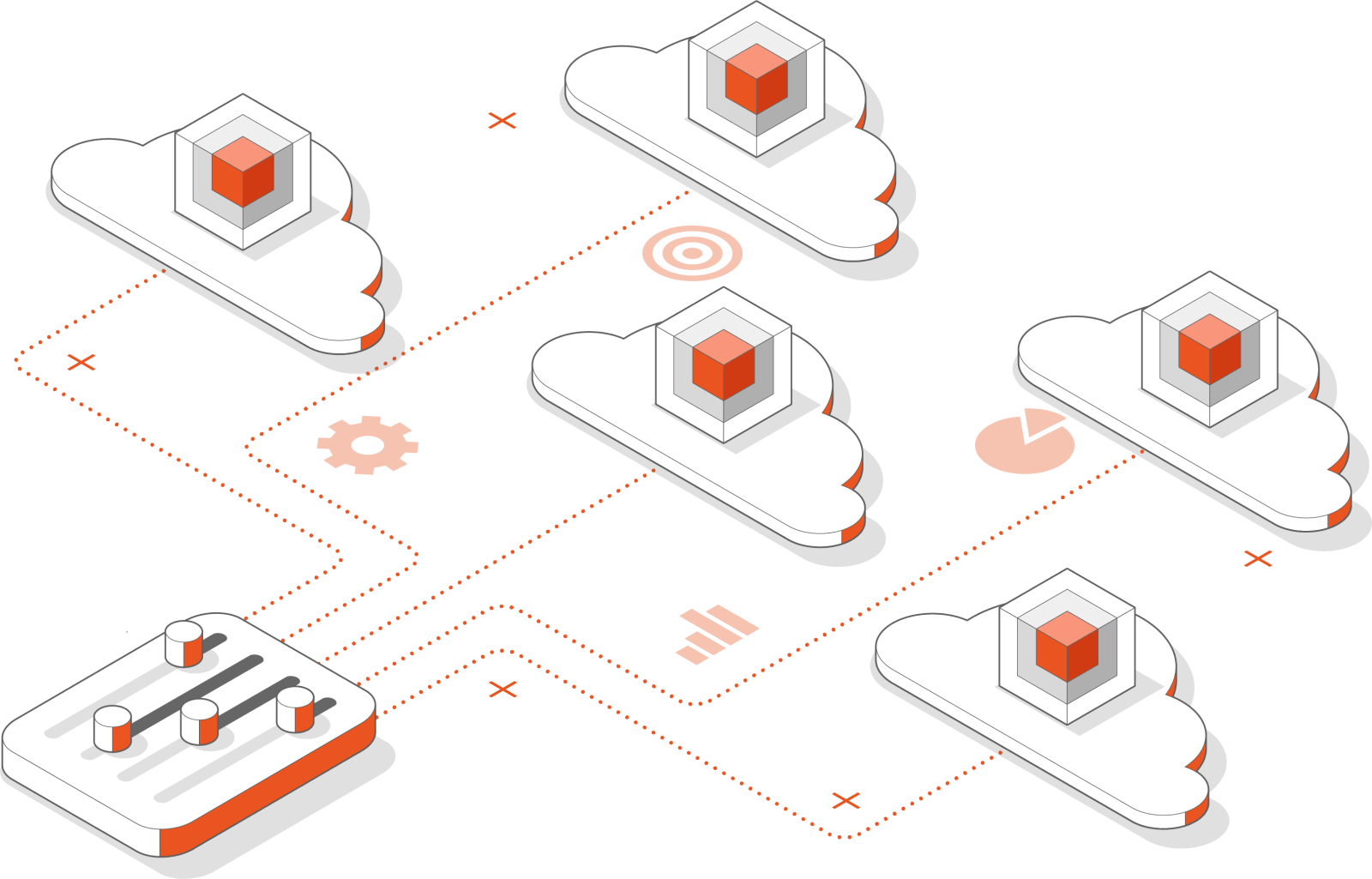
Private cloud software manages compute, network and storage assets that are available on individual servers, but are distributed across the entire data center. The software aggregates this hardware capacity into pools, and uses virtualization technology to divide them into virtual resources that are then allocated to virtual machines (VMs). By adding a containerization layer on the top, organizations can also provision containerized workloads on-demand.
With private clouds, all resources are available exclusively to a single entity or a service. They are not shared with other tenants, resulting in increased resource availability. Moreover, during heavy load periods private cloud can dynamically scale-out, providing the required amount of resources. The private cloud software can either be installed on the existing servers in the data center or a completely new infrastructure built solely for the purpose of the private cloud implementation project.
Public cloud vs private cloud
In principle, the main difference between private and public clouds is in their tenancy model.
Private cloud is a single-tenant environment where all resources are available to a single entity or a service. In contrast, public cloud is a multi-tenant environment where all resources are shared among various tenants (various organizations, services or end users) who typically do not know each other at all.
Another significant difference is in the total cost of ownership (TCO). Public clouds offer pay-as-you-go (PAYG) billing, which means they tend to be more economical in the short term, and on a small scale. However, as the number of workloads continues to grow, the costs of using the public cloud grow too, leading to an inflation of TCO. Thus, using a cost-effective private cloud as an extension of the public cloud infrastructure in a hybrid cloud architecture is key to optimizing infrastructure costs.
Private cloud benefits
The main benefit of a private cloud is better economics compared to public clouds when running workloads long term and at scale. Well-designed private clouds provide the same capabilities as leading public cloud providers, while offering advantages in other areas over public cloud. These include:
Long-term cost savings
While building a private cloud infrastructure requires significant upfront costs, this investment pays off after a couple of years - even with dozens of lightweight VMs
Predictable pricing
Due to various additional charges, public cloud pricing is totally unpredictable. At the same time, private cloud pricing is usually fully transparent, enabling predictable budgeting.
Increased performance
As private clouds usually run on an organization's premises and there is no resource sharing, they usually provide better performance compared to public cloud infrastructure.
Architectural freedom
When building a private cloud, the organization decides which hardware and software to use, resulting in increased flexibility and architectural freedom.
Security and compliance
While public clouds are usually considered more secure than private clouds, in some cases having full control over the underlying infrastructure helps organizations to meet their regulatory compliance requirements.
Private cloud challenges
While private clouds bring a number of benefits to organizations, implementing a private cloud infrastructure entails a number of challenges. Those include:
High CapEx cost
Due to significant hardware and software costs, private clouds are not as attractive on day 0 as public clouds. The cost benefits are typically felt later in the project cycle. To deal with that, organizations should always design the private cloud for price-performance by starting small and evolving according to their needs.
Capacity management
In a private cloud environment, organizations are responsible for capacity management to ensure the desired resource consumption. This creates an additional overhead on the internal cloud operations team. Using an effective observability stack ensures constant private cloud monitoring and proactive capacity management.
On-demand scalability
When a private cloud is running out of resources, it can dynamically scale out as long as additional resources are available in the data center. Without these additional resources, it may take longer to scale to higher demands, due to the long delays associated with the procurement process for new hardware.
Is a private cloud right for you?
The decision whether to host cloud workloads in a public cloud or in a private cloud is usually driven by economics.
While public clouds provide an immediate access to the infrastructure-as-a-service (IaaS) with no upfront costs, their TCO can grow rapidly depending on the number of workloads and the project timeframe.
On the other hand, private clouds prove to be more cost-effective when running workloads long term and at scale, but they require significant upfront investments. Therefore, using a hybrid cloud architecture is usually the way to achieve infrastructure cost optimization.
Get cost estimates for an enterprise private cloud on Ubuntu ›
Private cloud use cases
Among hundreds of possibilities, typical private cloud use cases include:
Private cloud architecture
Private cloud architecture does not differ much from the architecture used by public clouds. In practice, private clouds resemble public cloud behavior. They provide centralized management capabilities over compute, network and storage resources distributed across the data center and enable on-demand provisioning of virtualized resources through a self-service portal. To fulfill this role, private clouds use several technologies:
Virtualization
Provides a layer of abstraction over pools of physical resources and enables dynamic allocation of chunks of those resources into VMs and containers.
Management software
Grants organizations centralized management capabilities over both the underlying infrastructure and workloads and handles provisioning, scheduling and termination tasks.
Automation
Allows repetitive execution of complex tasks that would normally have to be performed manually, making private cloud faster, more reliable, and more flexible than traditional virtualization environments.
In addition, private cloud users can extend their infrastructure with bare metal provisioning, object storage and container coordination capabilities to increase their agility and improve data resiliency.
Types of private cloud
Depending on where the private cloud runs and who manages it, the following types of private cloud can be distinguished:
On-premises private cloud
In this case the cloud is deployed on the organization's premises, inside their own data center. The customer provides hardware and hosting facilities, and usually takes care of the private cloud maintenance and operations. On-premises private clouds are best for large enterprises which have existing physical infrastructure and enough human resources to manage the cloud.
Hosted private cloud
In this case, the private cloud runs in a data center that is outside the organization's facilities. The customer is still responsible for providing the hardware, but all hosting facilities (space, electricity, cooling, etc.) are delivered by the service provider. Hosted private clouds are best for organizations that do not have their own data center and which are not going to build one in the foreseeable future.
Managed private cloud
The private cloud is fully managed by a third party organization, sometimes called a managed service provider. The customer provides the hardware, but cloud operations and maintenance tasks are outsourced. The cloud can either run on the organization's premises or in the managed service provider data center. Managed private clouds prove to be more economical for up to hundreds of nodes, because they do not require hiring a dedicated operations team.
How do you build a private cloud?
Building a private cloud usually entails a number of challenges:
- What private cloud platform to standardize on?
- What hardware to choose?
- Which architecture to follow?
Those are just examples of questions organizations have to ask themselves at the beginning of their private cloud journey. Fortunately, there are tools that enable single-node private cloud installation for testing purposes. In more complex environments, private cloud providers like Canonical offer consulting services for private cloud deployment. Those usually include existing workloads assessment, architecture guidance, TCO prediction, cloud deployment and workloads migration.
Get in touch with Canonical for private cloud design and delivery ›
All you need for your private cloud

Canonical OpenStack is an enterprise cloud platform engineered for price-performance that serves as a cost-effective extension to hyperscale infrastructure.

Ubuntu Pro is the most comprehensive subscription for open source software security and compliance on the cloud.
Ubuntu Pro offers a unified security standard for your entire cloud journey – from public hyperscalers like AWS, Azure, and Google Cloud, to private OpenStack or hybrid deployments. It provides out-of-the-box FIPS, DISA-STIG, and FedRAMP hardening, and up to 15 years of security maintenance, ensuring your cloud security is consistent, governed, and maximized for uptime.